For fifty years, software waited for instructions. Now it is learning to act — and how companies are built, run and valued will change with it.
BPDA is a private holding company based in Bochum, Germany. It holds stakes in companies and advises on go-to-market, brand strategy and artificial intelligence in private ventures.
2026
Machines are learning to do the work, not just support it.
For fifty years, software has been a tool: a person sits in front of a screen and operates it. Agentic systems break with that arrangement. They research, weigh options, and carry out entire processes on their own — planning several steps ahead, choosing their own tools, correcting course when something fails. The constraint was never ambition; it was that machines could not handle open-ended work. That constraint is now falling, and it is falling faster than most organizations have priced in. The question is no longer which tasks a program can make easier, but which roles it can hold — and what the people who held them do next. This is not automation making existing work cheaper. It is a reorganization of who does the work at all.
The software industry is dismantling its own business model.
Per-seat licences, feature roadmaps, land and expand — the grammar of the SaaS era rested on one assumption: people operate software, and more people means more revenue. For two decades that assumption held so reliably that an entire industry was financed on it. Once agents do the operating, it stops holding. A company of two hundred seats becomes a company of twelve — plus a fleet of agents that no one licenses per head. What replaces the old model is still being negotiated: pricing tied to outcomes rather than access, products that ship as workers rather than tools, and companies smaller, faster and more capital-efficient than anything the industry has produced so far. The incumbents' playbook does not need updating. It needs replacing.
Go-to-market is being rewritten.
The most telling signal is a job title that barely existed three years ago: the GTM engineer. Go-to-market is ceasing to be a department that runs campaigns and becoming a system that gets built — data, signals, agents and workflows assembled into a revenue engine and maintained like a codebase. The gap this opens is already measurable: in BCG's 2026 survey of 300 CMOs, 96 percent claim an end-to-end AI transformation of their function, while roughly a third have actually done the work — and the small group that has reports threefold returns and campaign cycles ten times faster. Meanwhile the funnel itself is moving. Buyers increasingly discover, compare and decide inside AI assistants, without a single click. If the answer machines do not surface you, no budget will make you visible — which is precisely where brand begins.
As technology accelerates, the brand becomes the constant.
Technology now compounds at a pace that defeats human intuition; most people — and most companies — persistently underestimate exponential curves. That has a paradoxical consequence. When any capability can be replicated within months, technology alone stops being a moat, and the durable difference shifts to what cannot be copied on a roadmap: relationships, reputation, recognition. In a contest for attention, talent and capital that grows harder every cycle, brand is becoming equivalent in weight to the technology itself. The two compound side by side — one exponentially, in public; the other slowly, through trust. The companies that understand both curves will own the next decade. Most understand only one.
The most consequential changes happen out of sight.
Consumer applications get the headlines. The deeper transformation is under way in industrial and B2B value chains — in order books, maintenance schedules, pricing decisions, the unglamorous machinery that moves the real economy. These are the places where decades of process knowledge meet systems that learn, and where a single percentage point of efficiency is worth more than entire consumer categories. The data was always there; it was too messy, too fragmented, too expensive to use. That constraint is falling. What follows is not efficiency gains at the margin but a rebuilding of how industrial businesses are run — less visible than the consumer wave, harder to build, and worth considerably more.
About
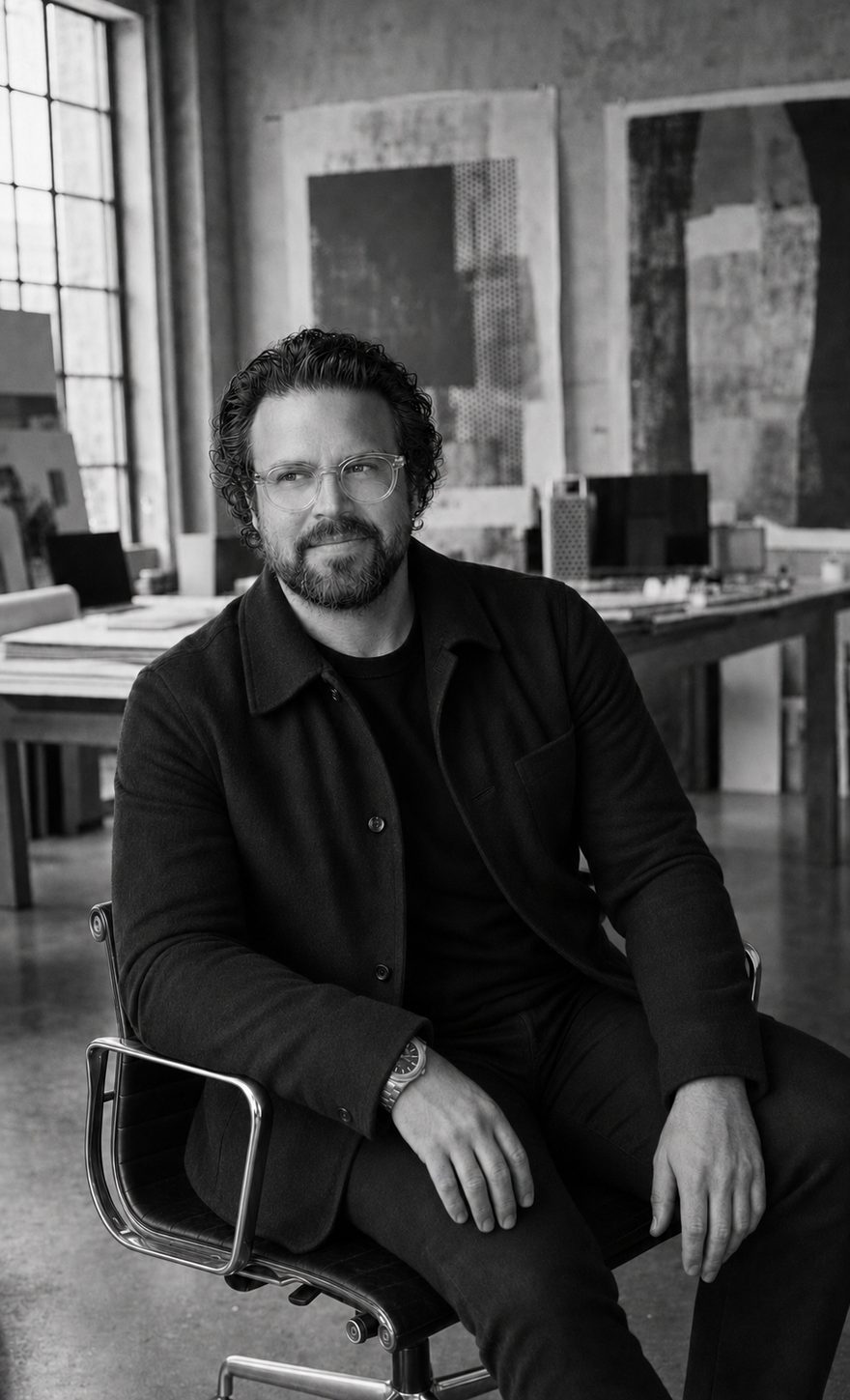
Philipp Boehmert
Founder
Philipp has spent more than two decades in digital B2B — as founder, executive and management board member.
It began in 2004, in his living room: a first company, founded at a time when much of the digital world was still taking shape — first steps in code, in marketing, in what would later be called GTM. From there he moved into performance marketing and the architecture of e-commerce systems.
Then, in 2012, came autosen: the Essen-based ifm group's attempt — unusual for the German Mittelstand of its day — to bring industrial technology to market the way software is: online, directly, without a field sales force. Brought in at the very start, he built the company across e-commerce, marketing, sales and operations — a decade on its management board, working closely with the founder of the ifm group, Gerd Marhofer.
Today he is Chief Marketing Officer of SalesViewer®, the leading sales-intelligence software in the German-speaking market — a role he has held since 2022 — responsible for global marketing, business development and the transformation of the product itself.
Contact
BPDA does not advertise, does not publish, and maintains no presence beyond this page. Mail is read.
BPDA — Boehmert & Partner Digital Advisory
Bochum, Germany